

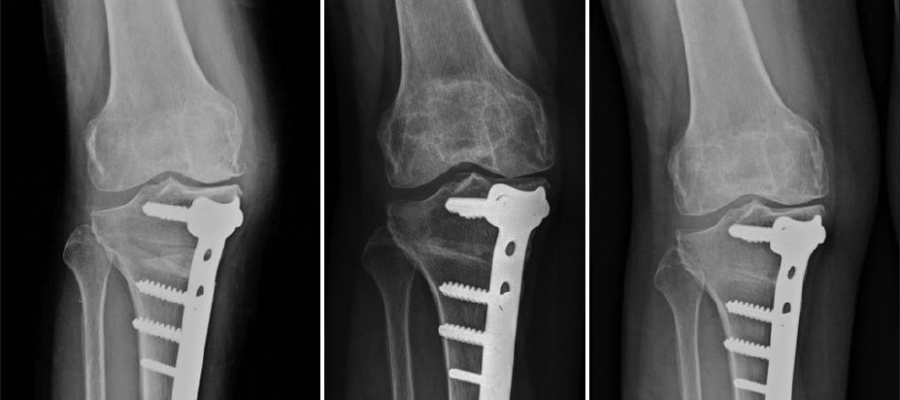
What is High Tibial Osteotomy?
High tibial osteotomy (HTO) is a widely performed procedure to treat medial knee arthrosis. If one part of the joint is worn out, the angle of the leg bone can often be changed to shift stresses onto other areas that are not so worn. This procedure can produce years of pain relief, as an alternative to joint replacement, in appropriate patients.
The ideal candidate for an HTO is a middle aged patient (45 to 65 years of age), with isolated medial osteoarthritis, with good range of motion and without ligamentous instability. HTO significantly affects a subsequent total joint replacement. Precise indication, preoperative planning, and operative technique selection are essential to achieve good results.
Purpose
There are two main reasons to perform high tibial osteotomy:
- For patients with medial compartment arthritis and a varus knee, its purpose is to provide years of relief prior to knee replacement. This is particularly important in patients too young to be optimal candidates for knee replacement.
- The other reason it is done is to correct malalignment in patients undergoing another procedure such as Carticel implantation. In these patients the HTO is performed to protect the cartilage replacement from failure due to excessive compressive forces on the graft.
HTO techniques
There are various HTO techniques including closing wedge osteotomy, opening wedge osteotomy, dome osteotomy, progressive callus distraction, and chevron osteotomy.
- Medial Opening Wedge Osteotomy- Medial opening wedge osteotomy is a relatively simple procedure that involves a single osteotomy and a few dissections. The technique does not necessitate either a fibular osteotomy that has been associated with neurovascular complications or bone resection of the lateral tibia.
- Lateral Closing Wedge Osteotomy- Lateral closing wedge osteotomy is effective for correction near maximal point of deformity. The technique allows rapid bone union due to the large contact surface of cancellous bone at the osteotomy site, early weight bearing and rehabilitation, and the use of quadriceps femoris muscle force.
- Other Techniques- Other HTO techniques include dome osteotomy, progressive callus distraction using an external fixator, and chevron osteotomy.
Outcome
For most patients, osteotomy is successful in relieving pain and delaying the progression of arthritis in the knee. It can allow a younger patient to lead a more active lifestyle for many years. Even though many patients will ultimately require a total knee replacement, an osteotomy can be an effective way to buy time until a replacement is required.
Common FAQs
Most patients begin walking with support (crutches) within the first few weeks, with partial weight-bearing initially and gradual full weight-bearing over time. Full recovery typically takes about 3–6 months, and return to sports or high-impact activities may take 4–6 months or longer depending on progress and physiotherapy.
Walking usually starts early with support. Initially you may use crutches or a walker with limited weight-bearing. As healing progresses, your surgeon and physiotherapist will advise when you can increase weight-bearing and walk more normally.
Return to work depends on your job and knee recovery. Many patients return to light or desk-based work within a few weeks, but physically demanding jobs or sports may take several months before being safe to resume.
Like any bone surgery, potential risks include infection, delayed bone healing or non-union, stiffness, irritation from hardware (plates/screws), nerve or blood vessel issues, and swelling. Regular follow-ups and good physiotherapy reduce these risks.
Yes, many patients are able to return to sport and active lifestyles. Most can resume low-impact activities by 3–6 months, and some return to higher-impact activities by 6–12 months depending on healing, age, fitness, and medical advice.