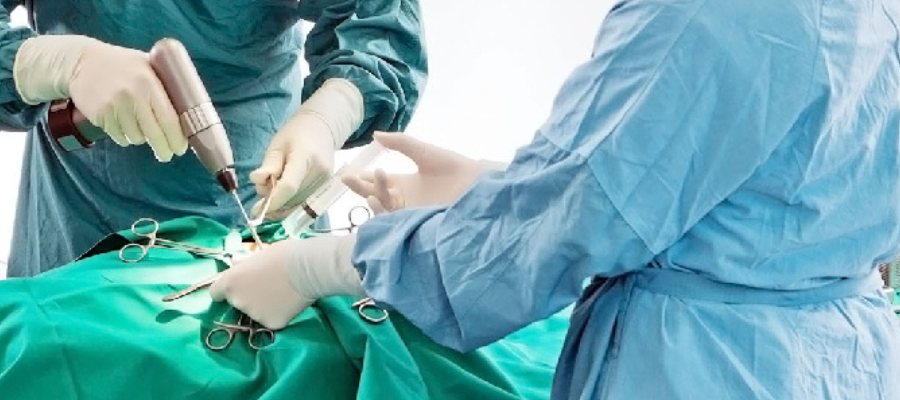

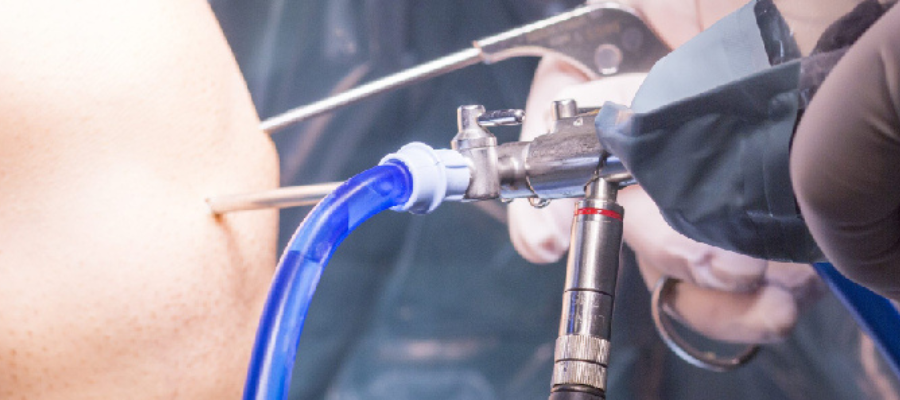
What is Knee Arthroscopy? Knee arthroscopy is a surgical procedure that allows doctors to view the knee joint without making a large incision (cut) through the skin and other soft tissues. Arthroscopy is used to diagnose and treat a wide range of knee problems. Anatomy: Your knee is the largest joint in your body and one of the most complex. The bones that make up the knee include the lower end of the femur (thighbone), the upper end of the tibia (shinbone), and the patella (kneecap). When Knee Arthroscopy is Recommended? Your doctor may recommend knee arthroscopy if you have a painful condition that does not respond to nonsurgical treatment. Nonsurgical treatment includes rest, physical therapy, and medications or injections that can reduce inflammation. Procedure Once you are moved into the operating room, you will be given anesthesia. To help prevent surgical site infection, the skin on your knee will be cleaned. Your leg will be covered with surgical draping that exposes the prepared incision site. At this point, a positioning device is sometimes placed on the leg to help stabilize the knee while the arthroscopic procedure takes place. A sterile solution will be used to fill the knee joint and rinse away any cloudy fluid. This helps your orthopaedic surgeon see the structures inside your knee clearly and in great detail. Types: ACL Reconstruction – ACL reconstruction is surgery to reconstruct the ligament in the center of your knee. The anterior cruciate ligament (ACL) connects your shin bone (tibia) to your thigh bone (femur). A tear of this ligament can cause your knee to give way during physical activity. Why it is performed ? If you do not have your ACL reconstructed, your knee may continue to be unstable. This increases the chance you may have a meniscus tear. ACL reconstruction may be used for these knee problems: Knee that gives way or feels unstable during daily activities Inability to return to sports or other activities When other ligaments are also injured When your meniscus is torn Nonsurgical Treatment : In nonsurgical treatment, progressive physical therapy and rehabilitation can restore the knee to a condition close to its pre-injury state and educate the patient on how to prevent instability. This may be supplemented with the use of a hinged knee brace. However, many people who choose not to have surgery may experience secondary injury to the knee due to repetitive instability episodes. Surgical Treatment : ACL tears are not usually repaired using suture to sew it back together, because repaired ACLs have generally been shown to fail over time. Therefore, the torn ACL is generally replaced by a substitute graft made of tendon. PCL Reconstruction – The posterior cruciate ligament, or PCL, is the strongest ligament of the knee. The posterior cruciate ligament’s most important function is to prevent posterior translation of the knee at higher knee flexion angles. Thus, patients commonly complaining of problems with deceleration, problems going down stairs and inclines or general twisting, turning or pivoting activities. PCL injuries are classified according to the amount of injury to the functional ligament: Grade 1 PCL Sprain: partial PCL tear Grade 2 PCL Tear: near complete PCL tear Grade 3 PCL Tear: a complete PCL tear – the ligament is non-functional When to Have PCL Surgery ? In general, PCL surgery is performed on all injuries that present themselves as a grade 3. In a higher level athlete, it may be recommended to proceed with a PCL reconstruction sooner because the results of acute reconstructions are much better than chronic reconstructions. Meniscus Surgery – You have two C-shaped discs of cartilage (soft tissue) that connect your thighbone to your shinbone. These are called menisci. They’re like shock absorbers for your bones. They also help to keep your knee stable. If you tear your meniscus, your leg might swell and feel stiff. You might feel pain when twisting your knee, or be unable to straighten your leg fully. Treatment Options : The treatment of a meniscus tear depends on its severity, location, and underlying disease within the knee joint. Patient circumstances also may affect the treatment options. Often it is possible to treat meniscus tears conservatively without an operation using anti-inflammatory medications and physical therapy rehabilitation to strengthen muscles around the knee to prevent joint instability. Partial meniscectomy- In this procedure, the damaged meniscus tissue is trimmed away. Meniscus repair-Some meniscus tears can be repaired by suturing (stitching) the torn pieces together. Whether a tear can be successfully treated with repair depends upon the type of tear, as well as the overall condition of the injured meniscus. Because the meniscus must heal back together, recovery time for a repair is much longer than from a meniscectomy. Recovery After surgery, you will be moved to the recovery room and should be able to go home within 1 or 2 hours. Be sure to have someone with you to drive you home and check on you that first evening. While recovery from knee arthroscopy is faster than recovery from traditional open knee surgery, it is important to follow your doctor’s instructions carefully after you return home. Pain Management After surgery, you will feel some pain. This is a natural part of the healing process. Your doctor and nurses will work to reduce your pain, which can help you recover from surgery faster. Medications- In addition to medicines for pain relief, your doctor may also recommend medication such as aspirin to lessen the risk of blood clots. Swelling- Keep your leg elevated as much as possible for the first few days after surgery. Apply ice as recommended by your doctor to relieve swelling and pain. Bearing Weight- Most patients need crutches or other assistance after arthroscopic surgery. Your surgeon will tell you when it is safe to put weight on your foot and leg. Rehabilitation Exercise- You should exercise your knee regularly for several weeks after surgery. This will restore motion and strengthen the muscles of your leg and knee. Common FAQs Is knee arthroscopy painful? Knee arthroscopy is usually not very painful because it is a minimally